
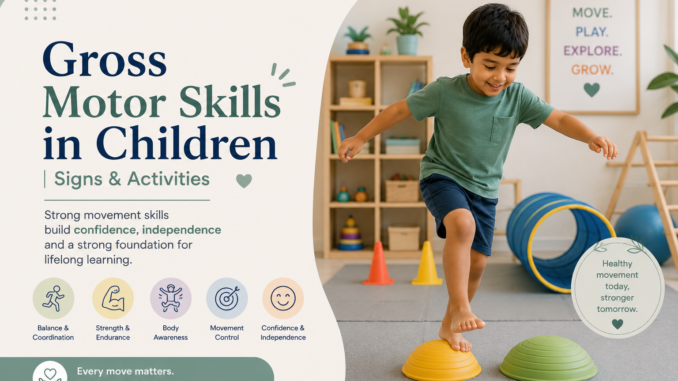
Running, jumping, climbing, balancing, throwing, and kicking may look like simple activities, but they require many different skills to work together. Gross Motor Skills in Children develop through movement and play and form an important foundation for physical independence, confidence, school participation, and everyday activities. When children have difficulty with these skills, parents may notice that they avoid playground activities, struggle to keep up with peers, or appear less confident during physical play.
Gross motor development does not mean every child needs to become an athlete. It is about helping children develop the strength, balance, coordination, and body awareness required to participate comfortably in everyday movement.
What Are Gross Motor Skills?
Gross motor skills involve the large muscles of the body, including the legs, arms, torso, and core.
Children use these skills when they:
- Sit upright
- Stand
- Walk
- Run
- Jump
- Climb
- Hop
- Kick a ball
- Throw and catch
- Ride a bicycle
- Participate in sports
These skills also contribute to other areas of development.
For example, good core stability can support a child when they sit at a desk, while balance and coordination are important during playground activities.
Signs of Gross Motor Difficulties
Children develop at different rates, but parents may want to seek guidance when movement difficulties consistently interfere with everyday activities.
Some signs can include:
- Frequent difficulty maintaining balance
- Avoiding running or jumping games
- Struggling to climb playground equipment
- Difficulty catching or throwing a ball
- Becoming tired quickly during physical activities
- Frequently bumping into objects
- Difficulty coordinating both sides of the body
- Appearing hesitant during movement activities
- Avoiding sports or group games
A child who avoids physical activities is not necessarily uninterested in playing.
Sometimes avoidance happens because the child knows an activity feels difficult.
For example, a child who struggles to maintain balance may avoid cycling because it feels challenging, while another child with coordination difficulties may avoid ball games because they are unable to predict where the ball will go.
Why Gross Motor Skills Matter
Movement is connected to much more than physical fitness.
Strong gross motor skills can support:
Confidence: Children are more likely to participate when they feel capable.
Social interaction: Many childhood friendships develop through games and physical play.
School participation: Children need movement skills for physical education, playground activities, and navigating school environments.
Independence: Activities such as climbing stairs, carrying objects, and getting on and off equipment require coordination and balance.
Body awareness: Children gradually learn where their body is in relation to objects and other people.
How Occupational Therapy Can Help
At Shaping Therapies Thane, Occupational Therapy can help children develop the movement foundations needed for participation in everyday activities.
Therapists may work on:
- Balance
- Coordination
- Core stability
- Body awareness
- Motor planning
- Strength
- Bilateral coordination
- Postural control
Activities are adapted to the child’s abilities and interests.
A child may work on balance through games, obstacle courses, climbing activities, ball play, or movement challenges rather than repetitive exercises.
This makes therapy more engaging while still targeting important developmental skills.
Fun Activities Parents Can Try
Parents do not need expensive equipment to encourage gross motor development.
Simple activities can include:
Obstacle courses: Use cushions, hoops, safe household objects, or cones to create a simple movement course.
Animal walks: Encourage children to move like a bear, crab, frog, or penguin.
Ball games: Rolling, kicking, throwing, and catching a ball can support coordination.
Hopscotch: This can help develop balance, rhythm, and single-leg coordination.
Dancing: Following music encourages movement, rhythm, and body awareness.
Outdoor play: Running, climbing, and exploring safe playground equipment provide natural opportunities for movement.
The most important factor is making movement enjoyable.
Don’t Compare Physical Development
Parents sometimes worry when another child runs faster, climbs higher, or learns to ride a bicycle earlier.
Comparison can create unnecessary pressure.
Instead, look for your child’s own progress.
Can they balance for longer?
Are they more willing to climb?
Can they catch the ball more often?
Are they becoming less hesitant during physical play?
These small improvements matter.
Creating a Positive Relationship With Movement
Children who associate movement with criticism may become even more hesitant to participate.
Instead of saying:
“You’re not doing it properly.”
Try:
“Let’s try it together.”
Instead of focusing only on performance, celebrate participation.
“You climbed one step higher today.”
“You caught the ball!”
“You tried something new.”
Positive encouragement helps children associate movement with confidence rather than fear of failure.
At Shaping Therapies Thane, our approach focuses on helping children develop practical movement skills in a supportive environment. Located within the peaceful grounds of Singhania School, our centre provides space for children to learn through movement and play.
Gross motor development is not about being the fastest runner or best athlete. It is about giving children the physical foundations they need to explore their environment, participate in play, develop independence, and feel confident in their bodies.
With appropriate opportunities, encouragement, and professional support when needed, children can continue developing these skills at their own pace.
Leave a Reply