
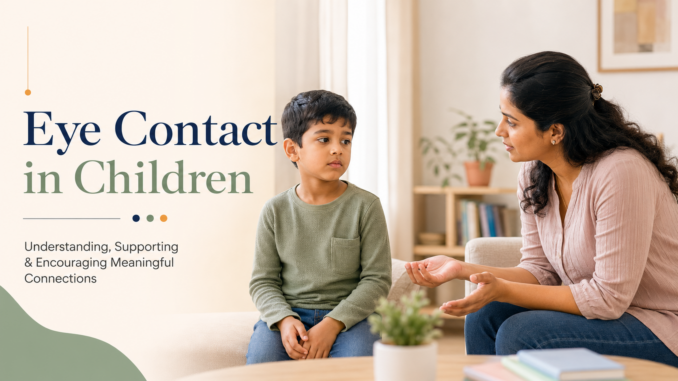
Many parents today are concerned about one growing habit among children: “Why does my child avoid eye contact?”While occasional distraction or looking away is completely normal, consistently avoiding eye contact can sometimes affect communication, learning, and social interaction. Eye contact is one of the earliest building blocks of communication and plays a crucial role in helping children understand emotions, connect with others, and participate confidently in conversations.
From infancy, babies begin making eye contact with their parents as a way of bonding, recognizing faces, and responding to voices. As children grow, eye contact becomes an important part of language development, emotional regulation, attention, and building meaningful relationships. When a child frequently avoids eye contact, parents naturally begin to wonder whether it is simply a personality trait or something that requires professional attention.
It is important to remember that every child develops at their own pace. Some children are naturally shy, while others may need extra support in developing social communication skills. Understanding the reason behind limited eye contact is the first step toward helping your child communicate with confidence.
Why Is Eye Contact Important for Child Development?
Eye contact is much more than simply looking at another person. It is an essential part of early childhood development and supports both verbal and non-verbal communication. Children learn a significant amount through observation, facial expressions, gestures, and eye movements before they are even able to speak fluently.
Maintaining eye contact helps children:
- Understand facial expressions and emotions
- Build trust and emotional connections
- Improve listening and attention skills
- Develop speech and language abilities
- Learn social rules and communication patterns
- Participate confidently in classroom discussions
- Strengthen relationships with parents, teachers, siblings, and friends
- Improve joint attention, which is an essential developmental milestone where a child shares focus on an object or activity with another person.
- Develop empathy by recognizing how others feel through facial expressions and body language.
Children who maintain healthy eye contact often find it easier to build friendships, participate in group activities, and express their thoughts effectively. Eye contact also improves a child’s ability to understand instructions, stay engaged during conversations, and respond appropriately in different social situations.
Signs That Your Child May Be Struggling with Eye Contact
Children who consistently avoid eye contact may:
- Seem disconnected during conversations
- Miss important social cues
- Have difficulty engaging with peers
- Struggle to follow verbal instructions
- Appear shy or withdrawn in group settings
- Frequently look away when someone is speaking
- Prefer playing alone instead of interacting with others
- Have difficulty responding during conversations
- Avoid looking at family members, teachers, or classmates during communication.
- Become easily distracted during face-to-face interactions.
- Show reduced confidence when meeting new people or participating in social settings.
These behaviors do not necessarily indicate a developmental disorder. Some children simply require additional support to strengthen their communication and social engagement skills.
Why Do Some Children Avoid Eye Contact?
There are several reasons why a child may avoid eye contact, and the cause can vary from one child to another.
Some common reasons include:
1. Natural Personality
Some children are naturally shy, introverted, or slow to warm up in unfamiliar environments. They may prefer observing before actively participating in conversations.
2. Sensory Processing Differences
Children with sensory sensitivities may find direct eye contact overwhelming because they are already processing multiple sensory inputs around them.
Bright lights, loud sounds, crowded environments, or excessive visual stimulation can make maintaining eye contact difficult.
3. Communication Difficulties
Children experiencing speech or language delays may avoid eye contact because communicating itself feels challenging.
When children struggle to express themselves or understand language, they may focus more on finding words than maintaining visual interaction.
4. Social Anxiety or Low Confidence
Some children become anxious during conversations and avoid eye contact because they feel nervous or unsure.
They may worry about making mistakes, answering questions incorrectly, or interacting with unfamiliar people.
5. Developmental Differences
In some cases, reduced eye contact may be associated with developmental conditions such as Autism Spectrum Disorder (ASD), Attention Deficit Hyperactivity Disorder (ADHD), sensory processing challenges, or global developmental delays. However, eye contact alone should never be used to diagnose any condition. A comprehensive developmental assessment by qualified professionals is always recommended.
Does Poor Eye Contact Always Mean Autism?
One of the most common concerns parents have is whether avoiding eye contact automatically means their child has Autism Spectrum Disorder (ASD). The simple answer is no.
Avoiding eye contact can occur for many different reasons, including:
- Shyness
- Anxiety
- Sensory sensitivities
- Speech and language delays
- Lack of social confidence
- Individual temperament
Autism is diagnosed based on multiple developmental factors, including communication, social interaction, behavior patterns, and developmental history—not eye contact alone.
If parents notice additional signs such as delayed speech, repetitive behaviors, difficulty responding to their name, limited social interaction, or challenges in pretend play, consulting a pediatric therapist or developmental specialist can provide clarity and guidance.
How Speech Therapy Helps Improve Eye Contact
At Shaping Therapies, Powai, Speech Therapy focuses on developing overall communication skills rather than forcing children to maintain eye contact.
Speech Therapy helps children:
- Improve expressive language
- Improve receptive language
- Develop conversation skills
- Build confidence while speaking
- Increase attention span
- Learn turn-taking during conversations
- Improve listening skills
- Strengthen social communication
- Develop joint attention and interactive play skills.
- Improve understanding of facial expressions and emotions.
As communication improves, children naturally become more engaged during conversations, resulting in better eye contact without pressure.
How Occupational Therapy Supports Social Engagement
Occupational Therapy addresses sensory processing, attention, emotional regulation, and functional participation.
Therapy sessions may include:
- Sensory integration activities
- Interactive play
- Fine motor skill development
- Emotional regulation strategies
- Attention-building exercises
- Social participation activities
- Visual tracking and attention exercises that encourage natural eye contact.
- Games that improve focus, listening, and cooperative interaction.
When children feel calm, regulated, and comfortable in their environment, maintaining eye contact often becomes easier and more natural.
Simple Ways Parents Can Encourage Eye Contact at Home
Parents play a vital role in strengthening communication skills through everyday activities.
Some effective strategies include:
- Sit face-to-face during meals
- Read picture books together
- Sing action songs
- Play peek-a-boo with younger children
- Encourage pretend play
- Reduce excessive screen time
- Use toys that encourage turn-taking
- Celebrate small communication successes
- Avoid forcing eye contact
- Narrate everyday activities while maintaining a warm, engaging facial expression.
- Use your child’s favourite toys or interests to naturally encourage interaction.
- Allow your child enough time to respond without rushing them.
- Praise communication efforts rather than focusing only on eye contact.
Remember, children learn best through enjoyable interactions rather than repeated correction.
When Should Parents Seek Professional Help?
Consider consulting a Speech Therapist or Occupational Therapist if your child:
- Consistently avoids eye contact
- Has delayed speech or language development
- Rarely responds to their name
- Has difficulty interacting with peers
- Shows limited social engagement
- Has sensory sensitivities
- Appears withdrawn during conversations
- Finds it difficult to follow simple instructions
- Has trouble expressing needs, emotions, or wants effectively.
- Shows little interest in communicating with family members or other children.
Early assessment allows therapists to identify developmental strengths and areas that need support before challenges become more significant. Early intervention has been shown to improve communication, learning, social interaction, and overall developmental outcomes.
Supporting Your Child’s Journey
Every child is unique, and communication develops differently for everyone. Avoiding eye contact does not automatically indicate a developmental disorder, but it is always worth understanding the underlying reason if the behavior persists.
At Shaping Therapies, Powai, our experienced Speech Therapists and Occupational Therapists provide individualized assessments and evidence-based therapy programs designed to strengthen communication, improve social interaction, support sensory regulation, and build lifelong confidence.
With early intervention, patient guidance, and active family involvement, children can make remarkable progress in eye contact, communication, emotional development, and social participation. Helping a child feel understood, confident, and connected today lays the foundation for stronger relationships and lifelong success tomorrow.
Leave a Reply