
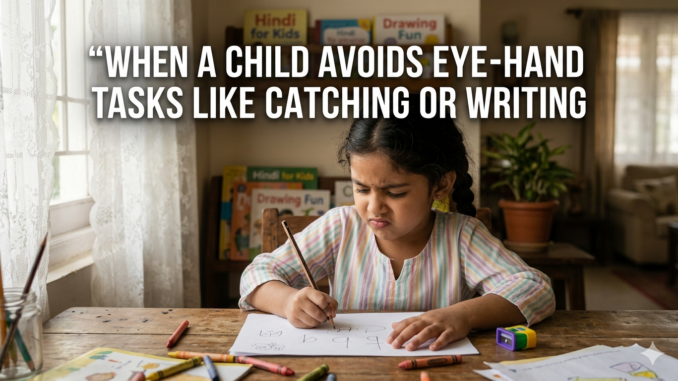
Many parents notice that their child avoids activities like writing, drawing, catching a ball, or completing craft projects. It is natural to wonder, “Why does my child avoid eye-hand coordination activities?” While this behavior is sometimes mistaken for laziness, disinterest, or a lack of effort, the reality is often very different.
Eye-hand coordination tasks require the brain, eyes, and hands to work together smoothly and efficiently. These activities involve visual processing, motor planning, muscle control, timing, balance, and concentration. If any of these skills are still developing, children may find everyday tasks challenging, tiring, or frustrating, leading them to avoid such activities altogether.
At Shaping Therapies, Powai – Mumbai, we frequently work with children who appear hesitant during tasks like writing, drawing, catching a ball, or even simple classroom activities. Understanding the underlying reasons behind this avoidance is the first step toward meaningful support.
Why Is Eye-Hand Coordination Important for Child Development?
Eye-hand coordination is the ability to use visual information to guide precise hand movements. It is one of the most important developmental skills that supports learning, independence, academic performance, sports participation, and everyday functional activities.
Strong eye-hand coordination helps children:
- Write neatly and efficiently
- Draw, colour, and complete art projects
- Catch, throw, and kick balls confidently
- Button clothes and zip jackets independently
- Use scissors safely and accurately
- Copy notes from the classroom board
- Complete puzzles and building activities
- Improve handwriting speed and pencil control
- Develop confidence during classroom and playground activities
- Perform self-care tasks with greater independence
As children grow, eye-hand coordination becomes increasingly important for both academic success and participation in sports, hobbies, and daily routines.
Understanding Eye-Hand Coordination
Eye-hand coordination refers to the ability to use visual input to guide hand movements. It is essential for many everyday activities, including:
- Writing and drawing
- Catching or throwing a ball
- Buttoning clothes
- Using scissors
- Copying from a board
For these tasks to feel effortless, the brain must accurately process what the eyes see, plan the movement, and send precise signals to the muscles controlling the hands and fingers. This entire process happens within seconds and requires multiple developmental systems to work together efficiently.
Signs That Your Child May Be Struggling with Eye-Hand Coordination
Children experiencing difficulties with eye-hand coordination may:
- Avoid writing or drawing activities
- Have messy or inconsistent handwriting
- Find colouring within lines difficult
- Struggle to catch, throw, or kick a ball
- Have difficulty copying from the classroom board
- Frequently drop objects
- Take longer than peers to complete schoolwork
- Grip pencils awkwardly or complain that writing is tiring
- Avoid puzzles, blocks, crafts, or construction toys
- Become frustrated during fine motor or sports activities
- Lose confidence when participating in classroom tasks or games
These signs often develop gradually and may become more noticeable as academic demands increase.
Why Some Children Avoid These Tasks
When eye-hand coordination is still developing, children may avoid these activities because they feel difficult or uncomfortable.
1. Difficulty with Visual Tracking
Children may struggle to follow moving objects, making catching or copying tasks challenging.
They may lose their place while reading, miss moving objects during play, or find it difficult to visually track objects from one location to another.
2. Poor Motor Planning
They may find it hard to plan and execute movements smoothly.
Motor planning difficulties can make simple tasks like drawing shapes, using scissors, or completing obstacle courses feel confusing and physically demanding.
3. Weak Hand Strength
Holding a pencil or controlling movements can feel tiring.
Reduced hand and finger strength may affect pencil grip, handwriting endurance, and the ability to manipulate small objects effectively.
4. Timing and Coordination Challenges
Tasks like catching require precise timing, which may not yet be developed.
Children may react too early or too late, making sports, playground activities, and classroom games more difficult.
5. Frustration from Repeated Difficulty
When children repeatedly experience difficulty, they may begin to avoid the task altogether.
Repeated unsuccessful experiences can lower motivation and make children reluctant to try new activities that require coordination.
How It Shows Up in Daily Life
You might notice:
- Avoidance of writing or drawing
- Messy or inconsistent handwriting
- Difficulty copying from the board
- Trouble catching or throwing a ball
- Frequent fatigue during fine motor tasks
- Difficulty using scissors or handling small classroom materials
- Avoidance of arts, crafts, or sports activities
- Taking longer than expected to finish homework
- Frequently asking for help with tasks that require hand control
These signs are often subtle but consistent.
The Emotional Impact
Avoidance is often linked to confidence.
When children feel that they are “not good” at something, they may:
- Withdraw from activities
- Avoid participation in class
- Feel frustrated or discouraged
- Become anxious before writing or classroom tasks
- Compare themselves with classmates or siblings
- Lose confidence in their abilities despite having good intelligence
Over time, this can affect both learning and self-esteem.
When children consistently experience failure or frustration, they may stop trying altogether, creating a cycle of avoidance that can affect academic progress, friendships, and emotional well-being.
Why Early Support Matters
The earlier these challenges are addressed, the easier it is to build foundational skills.
Without support, children may develop coping patterns such as avoidance, which can continue into later academic years.
Early intervention helps strengthen coordination, improve confidence, and prevent small developmental challenges from becoming long-term academic or functional difficulties. Supporting these skills during early childhood allows children to participate more successfully in school, sports, and everyday activities.
How Occupational Therapy Helps
At Shaping Therapies, Powai, Occupational Therapy focuses on strengthening the foundational skills required for eye-hand coordination rather than simply practising writing or catching repeatedly.
Therapy addresses visual perception, sensory processing, motor planning, hand strength, bilateral coordination, balance, posture, and fine motor control, helping children perform daily activities with greater ease and confidence.
Therapy includes:
- Visual tracking exercises
- Hand strengthening activities
- Coordination-based play
- Structured writing support
- Gradual exposure to challenging tasks
- Fine motor skill development
- Bilateral coordination activities
- Visual perception and visual-motor integration exercises
- Interactive games that improve timing, balance, and reaction speed
The approach is always child-friendly and paced according to the child’s comfort.
Every therapy program is individualized according to the child’s developmental needs, ensuring that learning remains enjoyable, motivating, and achievable.
Simple Ways Parents Can Support Eye-Hand Coordination at Home
Parents can support development through:
- Drawing and colouring activities
- Playing catch with soft balls
- Puzzle and building games
- Encouraging hands-on play
- Threading beads and lacing activities
- Playdough and clay exercises to strengthen hand muscles
- Simple cooking activities such as mixing or pouring
- Building with blocks or construction toys
- Encouraging outdoor games that involve throwing, catching, and kicking
The goal is to make practice feel natural, enjoyable, and pressure-free.
Celebrate small improvements, provide encouragement, and avoid comparing your child with others. Children develop coordination best when they feel supported and confident.
When Should Parents Seek Professional Help?
Consider consulting an Occupational Therapist if your child:
- Frequently avoids writing, drawing, or colouring activities
- Has persistent difficulty catching or throwing a ball
- Complains of tired hands during schoolwork
- Struggles with handwriting despite regular practice
- Finds self-care tasks like buttoning or using cutlery difficult
- Becomes easily frustrated during fine motor activities
- Shows delays in age-appropriate coordination skills
- Experiences challenges that affect school performance or daily independence
An early developmental assessment can help identify the underlying cause of these difficulties and provide targeted strategies that support long-term growth and learning.
Building Confidence Through Practice
As children begin to experience small successes, their confidence grows. They become more willing to try, participate, and engage, which further strengthens their skills.
With consistent therapy, regular practice, and positive encouragement, children gradually develop stronger coordination, greater independence, and increased confidence in both academic and recreational activities.
Supporting Your Child’s Development
Avoidance of eye-hand tasks is not about unwillingness. It is often a sign that a child needs support in developing coordination and control.
At Shaping Therapies, Powai – Mumbai, our experienced Occupational Therapists provide individualized assessments and evidence-based therapy programs designed to strengthen eye-hand coordination, fine motor skills, sensory processing, visual-motor integration, and overall functional independence.
With the right guidance, children can build these skills gradually and feel more confident in both academic and play environments.
Every child develops at their own pace. With early intervention, patient guidance, and active family involvement, children can make remarkable progress in coordination, learning, confidence, and independence. Helping your child strengthen these foundational skills today creates the pathway for lifelong success in school, sports, and everyday life.
Leave a Reply