
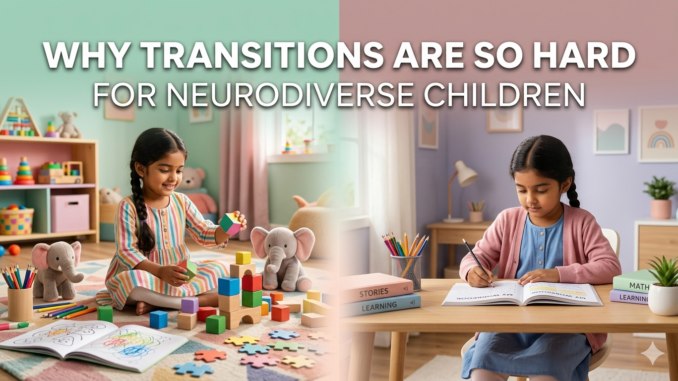
Why transitions are so hard for neurodiverse children is something many families experience daily- from moving between activities to adjusting to small changes in routine.
At Shaping Therapies, Thane, we often see that transitions are not just behavioural challenges, but deeply connected to how a child processes change, predictability, and control.
What Transitions Really Involve
Transitions are not just about stopping one activity and starting another. They require a child to:
- Shift attention
- Process new expectations
- Regulate emotions
- Let go of predictability
For neurodiverse children, each of these steps can feel overwhelming.
Why Change Feels Difficult
Many children rely on routine to feel safe. Predictability helps them understand what comes next.
When something changes- even something small it can feel like a loss of control.
This is why transitions can trigger strong emotional responses.
How It Shows Up
You may notice:
- Resistance to stopping activities
- Emotional outbursts
- Anxiety before transitions
- Difficulty shifting focus
These are not signs of defiance, but signs of overwhelm.
The Role of Regulation
A child who is already dysregulated will find transitions even harder.
Supporting emotional regulation first makes transitions easier to manage.
What Helps Children Manage Transitions
Small changes in approach can make a big difference:
- Giving advance warnings
- Using visual schedules
- Keeping routines consistent
- Allowing transition time
- Using simple, predictable language
These strategies help reduce uncertainty.
How Therapy Supports Transitions
At Shaping Therapies, Thane, therapy focuses on building:
- Flexibility
- Emotional regulation
- Predictability
- Coping strategies
Children are gradually exposed to change in a structured way, helping them feel more in control.
Building Tolerance to Change Over Time
Flexibility is not something that develops instantly. It is built through repeated, supported experiences.
With time, children learn that change does not always lead to discomfort.
Final Thoughts
Transitions are not about behaviour, they are about processing.
When we understand this, we move from reacting to supporting.
And that shift makes all the difference.
Leave a Reply