
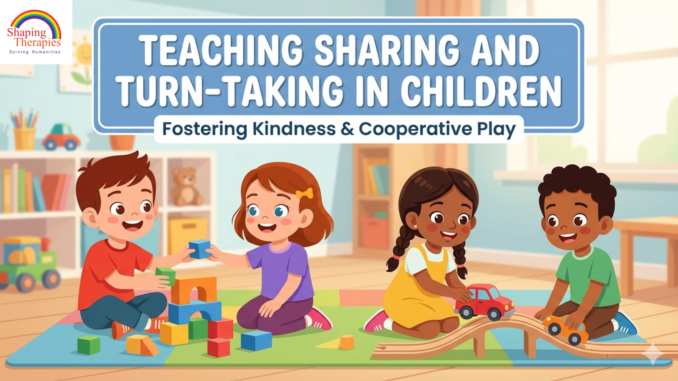
Teaching sharing and turn-taking in children is an essential part of early social development. Many parents feel concerned when their child struggles to share toys, wait for their turn, or cooperate during play. However, these are learned skills that develop gradually with guidance, practice, and maturity.
At Shaping Therapies, Powai, we support children in building these foundational social skills in a structured, supportive, and child-friendly way.
Why Sharing and Turn-Taking Take Time
Young children are still developing impulse control and emotional regulation. For them, waiting can feel uncomfortable, and sharing may feel like losing something important.
You may notice behaviours such as:
- Grabbing toys instead of waiting
- Getting upset when asked to share
- Difficulty understanding fairness
- Wanting control over play
These behaviours are developmentally appropriate but may need guidance to improve over time.
The Role of Emotional Regulation
Before children can share or take turns, they need to feel emotionally regulated. A child who is overwhelmed, tired, or frustrated is less likely to cooperate.
This is why simply telling a child to “share” may not always work. Supporting emotional readiness is just as important as teaching the skill itself.
Practical Ways to Teach Sharing
Parents can support learning through everyday play:
- Use clear phrases like “my turn” and “your turn”
- Start with very short waiting times
- Practice turn-taking games
- Model sharing behaviour consistently
- Praise effort, not just success
These small, repeated experiences help children understand expectations without feeling pressured.
How Therapy Supports Social Skills
At Shaping Therapies, Powai, therapy focuses on building social communication, patience, and flexibility through structured play-based sessions.
Children are guided to:
- Understand social cues
- Wait for turns in a supported setting
- Manage frustration during play
- Engage positively with peers
With consistent support, children become more confident in group settings and develop healthier social interactions.
Building Long-Term Social Confidence
Sharing and turn-taking are not just about play. They form the foundation for:
- Classroom participation
- Friendship-building
- Emotional resilience
- Cooperation in daily life
With early support, children can develop these skills in a natural and positive way.
Leave a Reply