
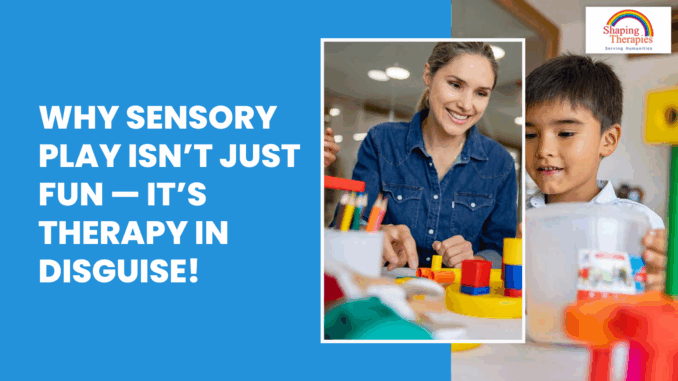
Introduction: Play That Heals, Not Just Entertains
Every parent loves watching their child explore — squishing clay, splashing in water, or building with sand. But here’s the thing: that “messy play” isn’t just fun. It’s powerful therapy in disguise. For many children, especially those facing developmental, sensory, or attention challenges, sensory play is one of the most effective ways to help their brain and body connect.
At Shaping Therapies, Thane, our occupational therapists design sensory-based activities that improve focus, motor skills, and emotional regulation — all through play. The best part? Kids don’t even realize they’re working hard; they’re just having fun.
What Is Sensory Play?
Sensory play involves activities that engage one or more of a child’s senses — touch, sight, hearing, smell, taste, balance, or movement. It helps the brain process information more efficiently, improving attention, coordination, and calmness.
Examples include:
- Playing with kinetic sand or slime (touch)
- Jumping on a trampoline (movement)
- Pouring water between cups (visual and tactile)
- Listening to soothing sounds or music (hearing)
- Exploring scented playdough (smell)
Each of these simple activities stimulates different parts of the brain, helping children respond better to their environment.
Why Sensory Play Matters for Child Development
Children naturally learn through exploration. But for kids who struggle with sensory processing, certain textures, sounds, or movements can feel overwhelming. Sensory play helps them learn how to manage and organize those sensations.
At Shaping Therapies, Thane, our occupational therapists use sensory play to:
- Develop fine and gross motor skills through hands-on movement and manipulation.
- Improve focus and self-regulation by calming the nervous system.
- Encourage social interaction during group sensory activities.
- Build emotional confidence by helping kids face and enjoy new sensations safely.
It’s not just about fun — it’s about strengthening the brain’s wiring for learning and daily life.
How Occupational Therapy Uses Sensory Play
At Shaping Therapies, Thane, sensory play is more than an activity — it’s a therapeutic tool. Our sessions are designed to match each child’s sensory needs and goals.
Here’s how we use it in practice:
| Challenge | Sensory Play Strategy | Therapeutic Goal |
| Overreacts to textures or sounds | Gradual exposure through messy play or soft sounds | Reduce sensory sensitivity |
| Poor balance or coordination | Activities like swinging, obstacle courses, or yoga | Improve body awareness and posture |
| Difficulty focusing | Deep-pressure activities like rolling, squeezing, or weighted play | Increase attention span |
| Emotional outbursts | Calming sensory bins, rhythmic music, or tactile play | Build self-regulation |
| Weak fine motor control | Bead threading, clay molding, or finger painting | Strengthen hand muscles and control |
Each session blends fun and function — children are guided to explore, engage, and build essential life skills without pressure.
Benefits of Sensory Play in Occupational Therapy
The long-term benefits of sensory play go far beyond playtime. Consistent participation helps children:
- Strengthen motor planning and coordination
- Enhance language and communication skills through interactive play
- Build emotional resilience and self-control
- Improve focus and learning readiness for school tasks
- Develop confidence by mastering new sensory experiences
Sensory play turns frustration into curiosity — and that’s where growth begins.
Parent Involvement: Making Therapy a Daily Routine
Parents play a vital role in extending the benefits of sensory play beyond therapy sessions. At Shaping Therapies, we guide families on how to create sensory-friendly environments at home — simple setups like a rice bin, textured toys, or a mini obstacle course can make a big difference.
We teach parents how to:
- Recognize when their child is overstimulated or under-stimulated
- Use sensory activities to calm or engage their child
- Incorporate short sensory breaks during homework or screen time
With consistency at home and therapy, the child’s ability to focus, regulate, and participate improves dramatically.
Why Choose Shaping Therapies, Thane?
As one of the leading occupational therapy centres in Thane, Shaping Therapies specializes in child-centered, play-based interventions. Our experienced occupational therapists blend fun with science — ensuring that every session targets real developmental goals while keeping your child motivated.
We provide sensory integration therapy, fine motor training, handwriting improvement, and emotional regulation programs — all personalized to each child’s unique sensory profile.
Conclusion: Play Is the Brain’s Favorite Way to Learn
Sensory play may look like fun and games, but it’s actually one of the most powerful tools for development. It teaches children how to focus, self-regulate, and adapt — skills that form the foundation for lifelong learning and emotional well-being.
At Shaping Therapies, Thane, we turn play into progress. Through expert guidance and engaging activities, we help children strengthen their sensory, motor, and emotional skills — one playful moment at a time.
If your child finds it hard to focus, handle textures, or stay calm during daily tasks, sensory-based occupational therapy could be the key. Book a consultation with our therapists in Thane today and discover how play can truly heal.