
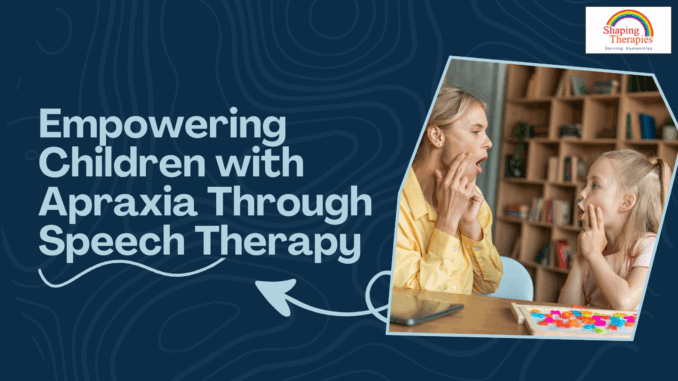
Introduction: Giving a Voice to Every Child
When a child knows what they want to say but can’t get the words out clearly, it can be deeply frustrating — for them and their parents. This struggle may not be about understanding or intelligence but about motor planning, the brain’s ability to coordinate the mouth and tongue to produce sounds. This condition is known as Childhood Apraxia of Speech (CAS).
At Shaping Therapies, Powai, our speech therapists specialize in helping children with apraxia find their voice through evidence-based, play-centered speech therapy. With the right guidance, patience, and consistent support, children with apraxia can learn to communicate confidently and effectively.
What Is Childhood Apraxia of Speech (CAS)?
Childhood Apraxia of Speech is a motor speech disorder where the brain has trouble planning the precise movements needed for speech. The child knows what they want to say, but the connection between their brain and speech muscles doesn’t work smoothly.
This results in speech that may sound unclear, inconsistent, or effortful. Unlike a simple articulation issue, apraxia affects the coordination and timing of movements, not just the sounds themselves.
Common signs of apraxia include:
- Limited variety of sounds or syllables used
- Difficulty imitating speech even though they understand instructions
- Inconsistent pronunciation of the same word
- Groping movements (trying to find the right mouth position)
- Slow speech progress despite regular practice
Recognizing these early helps begin intervention at the right time — when it can make the biggest difference.
How Speech Therapy Helps Children with Apraxia
Speech therapy for apraxia is highly individualized and focuses on helping the brain build new, accurate motor plans for speech. At Shaping Therapies, Powai, we use structured yet engaging techniques that make repetition feel like play.
Here’s how our therapy approach empowers children:
- Repetition and Practice
- Frequent, targeted practice helps strengthen the brain-muscle connection.
- Children work on producing specific sounds and word sequences repeatedly in fun, motivating contexts.
- Frequent, targeted practice helps strengthen the brain-muscle connection.
- Visual and Tactile Cues
- Therapists use gestures, visual prompts, and mirrors to help children understand mouth placement.
- Touch cues may guide them to feel how sounds are formed.
- Therapists use gestures, visual prompts, and mirrors to help children understand mouth placement.
- Breaking Down Speech Tasks
- Words are broken into smaller, manageable parts (syllables) before combining them into full sentences.
- This step-by-step process helps children gain accuracy and confidence.
- Words are broken into smaller, manageable parts (syllables) before combining them into full sentences.
- Rhythm and Melody Training
- Using rhythmic speech patterns, songs, or tapping helps children improve timing and prosody (speech rhythm).
- Using rhythmic speech patterns, songs, or tapping helps children improve timing and prosody (speech rhythm).
- Parent Involvement
- Parents are coached on daily home practice routines.
- Consistency between home and therapy sessions accelerates progress.
- Parents are coached on daily home practice routines.
Table: How Speech Therapy Supports Children with Apraxia
| Challenge | Speech Therapy Strategy | Outcome |
| Difficulty forming sounds | Visual/tactile cues, mirror work | Clearer articulation |
| Inconsistent speech | High-frequency repetition and practice | Improved accuracy and consistency |
| Slow speech rate | Rhythm-based activities and pacing tools | More natural speech flow |
| Limited vocabulary | Word expansion through play-based tasks | Stronger communication range |
| Low confidence | Positive reinforcement and gradual success | Increased motivation and self-esteem |
Why Early Intervention Matters
Early and consistent speech therapy can make a life-changing difference for children with apraxia. The brain is most adaptable during early childhood, making it the ideal time to build accurate motor speech pathways.
At Shaping Therapies, Powai, we design individualized programs for each child — combining repetition, sensory feedback, and emotional encouragement to make every session impactful. The goal is not just speech clarity, but communication confidence.
Our Approach at Shaping Therapies, Powai
We believe therapy should feel like discovery, not pressure. Our speech therapists use play-based learning, interactive games, and real-life communication tasks to make each session enjoyable and effective.
Our process includes:
- Comprehensive evaluation to understand the child’s speech patterns and needs
- Tailored therapy plan focusing on gradual, measurable progress
- Family collaboration to ensure practice continues outside therapy
- Regular progress monitoring and adjustments based on improvement
Beyond Words: Building Confidence and Connection
Speech is more than just words — it’s how children connect, express feelings, and build relationships. For kids with apraxia, learning to speak can feel like climbing a mountain, but every sound mastered is a step toward independence and self-expression.
At Shaping Therapies, Powai, we celebrate every small victory — the first clear word, the first confident conversation — because those moments redefine what progress looks like.
Conclusion: Every Voice Deserves to Be Heard
Apraxia may make speech difficult, but it doesn’t define your child’s potential. With the right therapy, persistence, and encouragement, children can learn to express themselves clearly and confidently.
At Shaping Therapies, Powai, our dedicated speech therapists are here to guide your child every step of the way — helping them turn effort into expression and silence into speech.
If your child struggles to form words or shows signs of apraxia, reach out to our team today. Let’s help them find their voice — one sound, one word, and one breakthrough at a time.