
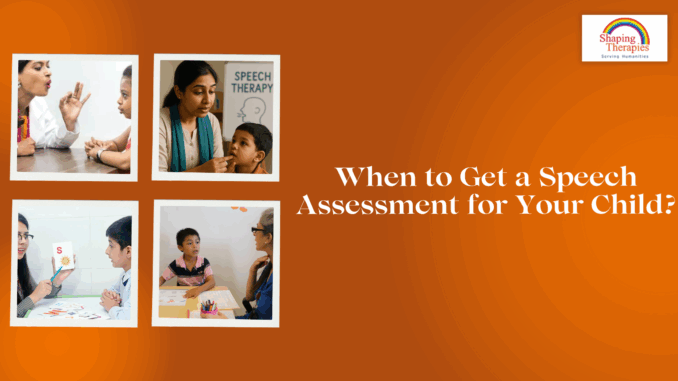
Introduction: Recognizing the Turning Point
As parents, we celebrate every “big” moment: first words, phrases, even sentences. But sometimes it’s the small, subtle concerns, a word left unsaid, a hesitation that nudge us to take action. A speech assessment at the right time can help confirm whether your child just needs a little space to grow or a bit of support to get their voice heard.
At Shaping Therapies, Powai, we understand that every child communicates in their own way and at their own pace. Our expert team supports parents in identifying speech concerns early and providing the right guidance. With personalized, play-based interventions, we help children build confident communication skills.
Understanding Speech Delay Versus Typical Variation
Not every child follows the exact same speech timeline. Some toddlers may speak late but quickly catch up, while others gradually fall further behind. The difference lies in whether a delay is temporary or persistent and that’s where a professional evaluation becomes valuable.
Real-Life Signs That It’s Time to Consider an Assessment
These aren’t rule-book milestones; they’re everyday cues parents don’t often connect with speech struggles:
→ Consistent frustration during requests—when a simple ask ❝I want juice❞ ends in tears
→ Relying solely on gestures like pointing, pulling your hand, or leading you to the fridge
→ Repeating the same word or phrase over and over to express different wants (“this” or “that” for everything)
→ Lack of curiosity about language not naming familiar items or animals
→ Echoing phrases instead of creating original responses
→ Silent play no sound effects or pretend voices during pretend play
If you recognize two or more of these behaviors regularly, it’s usually a good time to consider an assessment.
How Speech Assessments Work at Shaping Therapies, Powai
| Step | Description | Parent Involvement |
| Initial Consultation | A conversation to discuss observations, family history, and parental concerns | Parents share detailed background and concerns |
| Child Observation & Play Interaction | Therapist watches your child play and interact, looking at spontaneity of speech, play patterns, gestures | Parents may join or observe |
| Standardized Speech & Language Testing | Age-appropriate assessments measure vocabulary, pronunciation, sentence structure, fluency | Administered by the therapist |
| Sensory & Oral-Motor Screening | Checks for issues like tongue-tie, chewing/swallowing difficulties, or sensory sensitivities | Feedback helps adapt therapy strategies |
| Feedback Session | Therapist interprets results in a clear, jargon-free way, discussing whether therapy is recommended and why | Parents ask questions and help shape goals |
| Personalized Therapy Plan | A plan is developed with clear goals, home practice suggestions, and therapy rhythm | Parents learn “what, why & how” to support progress |
Why it’s better to Act Sooner rather Than Late
Starting speech therapy early increases the chance of improvement dramatically. Speech therapists work with neural plasticity that window when the brain is especially responsive to learning new patterns. The result isn’t just clearer speech, it’s enhanced confidence, social participation, and reduced frustration.
What the Right Assessment Uncovers
A thorough speech evaluation does more than identifying “delay.” It can reveal:
- Speech sound disorders (like lisp or articulation errors)
- Expressive vs. receptive language gaps
- Fluency issues such as developmental stuttering
- Phonological processing or word-finding difficulties
- Oral-motor or feeding concerns. Each diagnosis leads to a more focused therapy plan, so your child isn’t just starting therapy they’re starting smart therapy.
Supporting Speech Growth at Home
Assessment is only the start. Progress comes when home and clinic are aligned. Here’s how families can help:
→ Label toys, actions, and feelings out loud
→ Pause to let your child fill in words during sentences
→ Read together regularly, using voices and pointing out objects
→ Embed speech goals into fun routines sing songs, play pretend, cook together
How Shaping Therapies, Powai, Makes a Difference
At Shaping Therapies, Powai, we understand the emotional weight of a speech concern. That’s why our assessments are:
- Child-friendly—play-based and pressure-free
- Collaborative—we listen to parents just as much as children
- Comprehensive—we look at speech, language, feeding, sensory, and play
- Goal-driven—every plan is unique and measurable
we want every child grows confident in communication and every parent feels empowered.
Taking the Next Step
If you’re noticing the cues above or simply feel that “something is off” you don’t have to wait. Call Shaping Therapies, Powai, for a consultation. We’ll help you understand what to expect and whether an assessment is the right step, no pressure, just clarity.